Why Your Green Smoothie Turns Brown in the Fridge (and How to Stop It)
Quick Answer: Smoothies turn brown from oxidation — exposure to air breaking down pigments and compounds in the fruit and greens — and while it’s not unsafe to drink, a few specific prep changes slow the process meaningfully if a fresher appearance matters for meal-prepped batches.
Same smoothie, made the same way, looks vibrant fresh out of the blender and noticeably duller by the next morning.
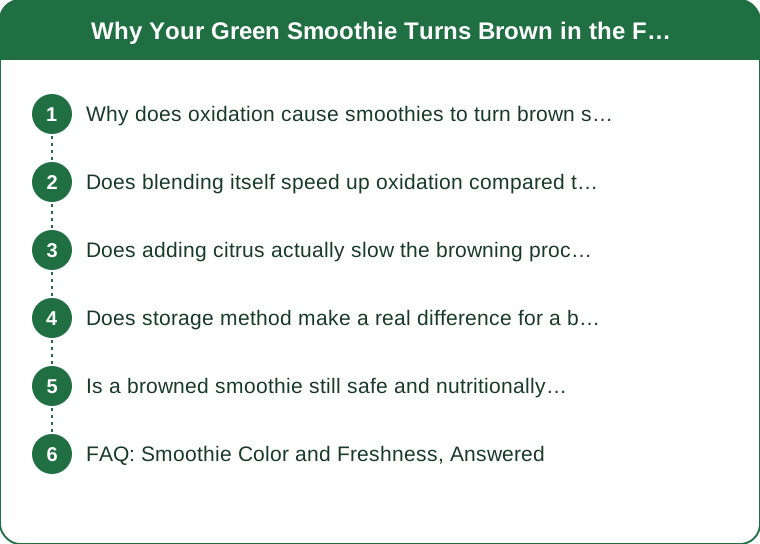
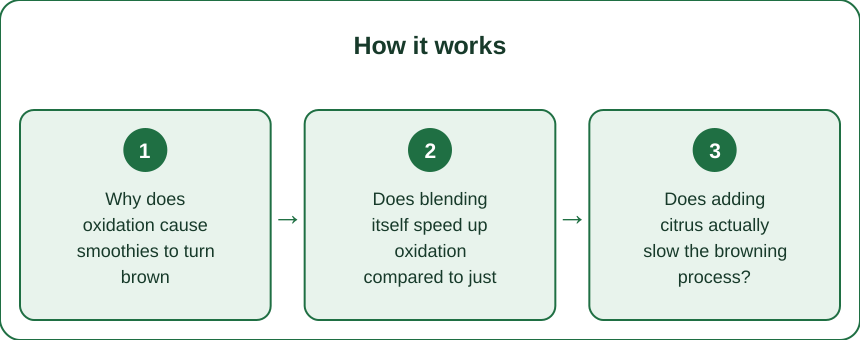
Why does oxidation cause smoothies to turn brown specifically?
Many fruits and greens contain compounds (like certain enzymes and polyphenols) that react with oxygen once cut or blended, breaking down the pigments responsible for bright color — this is the same basic chemical process that turns a cut apple brown, just happening at a smaller scale throughout a blended mixture.
Does blending itself speed up oxidation compared to just cutting fruit?
Yes, meaningfully — blending introduces significantly more air into the mixture and breaks down cell walls far more thoroughly than a knife does, exposing much more surface area to oxygen at once, which is why a blended smoothie browns faster than the same fruit would sitting cut on a plate.
Does adding citrus actually slow the browning process?
Yes — the vitamin C in citrus like lemon or lime acts as an antioxidant that competes with the oxidation reaction, genuinely slowing (though not fully stopping) the color change, which is why many smoothie recipes include a citrus component beyond just flavor.
Does storage method make a real difference for a batch-prepped smoothie?
Considerably — storing a smoothie in an airtight container filled as close to the top as possible (minimizing trapped air) slows oxidation more than a loosely covered or partially filled container, since less exposed air surface means less oxidation reaction happening at the top layer.
Is a browned smoothie still safe and nutritionally similar to drink?
Generally yes — the color change is primarily cosmetic from oxidation, not spoilage, so a browned smoothie made and stored properly (refrigerated, consumed within a day or two) is typically still safe, though some nutrient degradation does occur alongside the color change over time.
FAQ: Smoothie Color and Freshness, Answered
Does freezing smoothie portions prevent browning entirely?
Freezing significantly slows the oxidation reaction compared to refrigeration, making it a more effective option for smoothies prepped more than a day or two in advance.
Do certain greens brown faster than others in a smoothie?
Yes — some greens oxidize more readily than others due to differences in their enzyme content, so swapping greens is one variable worth testing if browning is a consistent issue.
Is there a taste difference once a smoothie has oxidized and browned?
Sometimes a mild change in freshness or brightness of flavor is noticeable, though it’s usually subtle rather than an obvious spoiled taste.
TL;DR:
- Browning is from oxidation breaking down pigments, the same reaction as a cut apple browning
- Blending speeds up oxidation more than simple cutting due to more air exposure
- Citrus (vitamin C) genuinely slows the browning reaction, not just flavor
- Airtight, fully filled storage containers reduce exposed air and slow browning
- A browned smoothie is typically still safe, with the change being mostly cosmetic
A squeeze of citrus and a well-sealed container go a long way toward keeping color fresher longer.
Keep Reading
This article is for general informational purposes only and is not medical advice. Always consult a qualified health professional for guidance specific to you.