Why Some Smoothie Ingredients Stay Gritty No Matter How Long You Blend
Quick Answer: Grit comes from particles your blender physically cannot reduce below the roughly 25-micron threshold where your tongue stops detecting them. Chia and flax hulls, raspberry and blackberry seeds, raw kale and chard cell walls, cocoa nibs, and undissolved protein powder all sit above it. Longer blending heats the mixture and breaks down texture elsewhere without touching those particles. The fixes are pre-soaking, straining, swapping the ingredient, or masking with fat.
The blender is rarely the problem, which is why upgrading it so often disappoints.
This blog has covered smoothie texture troubleshooting, the blend order thickness guide, and protein powder clumping. This is the category of grit that no technique removes.
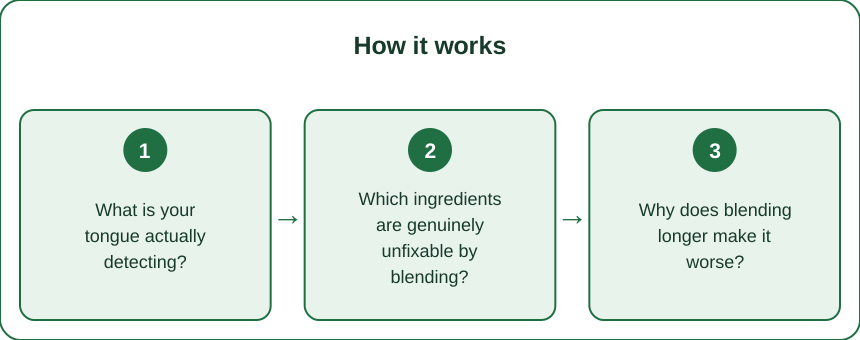
What is your tongue actually detecting?
Particle size, and the threshold is far lower than most people assume.
The human tongue detects particles from roughly 25 microns upward, which is why the same ingredient can feel smooth in one preparation and sandy in another.
Domestic blenders typically reduce soft matter to about 100 to 300 microns, and high-performance ones to somewhere around 50 to 100. Both are well above the detection threshold.
What makes a smoothie feel smooth is not that particles are absent but that they are suspended in enough viscous liquid that they never contact the tongue individually. Thickness masks grit.
Which is why the same smoothie is grittier when thin. Add water to a smooth smoothie and grit appears without a single new particle being introduced.
Fat masks grit particularly well. Nut butter, avocado, full-fat yoghurt and coconut milk coat particles and dampen the sensation dramatically.
And cold reduces perception too. A properly cold smoothie is perceptibly less gritty than the same mixture at room temperature, which is part of why they get worse as they sit.
Which ingredients are genuinely unfixable by blending?
A short and consistent list, all for structural reasons.
Raspberry, blackberry and kiwi seeds are hard, small and lens-shaped. Blades deflect them rather than cutting them. No consumer blender fixes this; straining does.
Chia and flax hulls resist shear. Whole flaxseed is worse — much of it passes through entirely, taking its nutrition with it. Ground flax and pre-soaked chia solve both problems.
Raw kale, chard and collard cell walls are heavily lignified. Spinach is not, which is precisely why spinach blends invisibly and kale does not. Massaging, freezing, or a 30-second blanch breaks those walls down.
Cocoa nibs and cacao powder that has not been dispersed stay gritty; the powder needs a liquid slurry first rather than being tipped onto ice.
Undissolved protein powder is a dispersion failure, not a grinding one. Whey and casein clump on contact with liquid unless the powder goes in before the frozen items and gets liquid first.
Frozen banana and mango are the opposite case — they break down completely and are the reason people think their blender handles everything.
And ice is a special problem. Ice does not go away; it becomes smaller ice, and it melts into a thinner mixture, which reveals grit that thickness was masking.
Why does blending longer make it worse?
Because you are heating and destabilising the parts that were working.
A blender adds significant heat. Ninety seconds on high in a powerful machine can raise the mixture by 10 degrees or more, and warmer means both more grit perception and faster oxidation.
Heat and shear break down fruit pectin, which is a major part of what was providing viscosity. Less viscosity means less masking, so the drink gets grittier as it gets more blended.
Ice melts, which thins the mixture for the same reason.
Over-blending also aerates. Foam has a distinct mouthfeel that people frequently report as grainy or separated, and it accelerates browning.
Meanwhile the hard particles are unchanged. Seeds, hulls and lignified cell walls are past the machine’s capability at 20 seconds and still past it at 120.
So the useful blending time is much shorter than people use — generally 45 to 60 seconds in a high-power machine, 60 to 90 in a standard one, and then stop regardless of texture.
What Nobody Tells You About Fixing Grit
Most of the effective interventions happen before the blender is switched on.
Soak first. Chia for 15 minutes, oats for 10, dates for 20 in hot water. Soaking softens structures that no blade reaches, and it costs nothing but planning.
Grind flax, never blend it whole. A whole flaxseed passes through both your blender and your digestive system largely intact.
Blanch kale for 30 seconds and shock it cold before freezing in portions. This single step is the difference between kale that disappears and kale you chew.
Strain seeded berries through a fine mesh sieve, or swap to blueberries and strawberries, which have far smaller seeds.
Add liquid first, powder second, frozen items last. Powder needs to hydrate in liquid, not sit on ice.
Add fat. A tablespoon of nut butter or a quarter avocado does more for perceived smoothness than any extra thirty seconds of blending.
And build thickness rather than fighting it. Frozen banana, avocado, oats or yoghurt raise viscosity, and viscosity is the real anti-grit mechanism. A thin smoothie will always feel grittier than a thick one made from identical ingredients.
FAQ: Smoothie Texture Questions, Answered
Why is my smoothie gritty even with a good blender?
Because certain particles — berry seeds, chia and flax hulls, raw kale cell walls, undissolved powder — sit above the roughly 25-micron threshold your tongue detects and below what any consumer blade reduces. It is a particle problem, not a power problem.
Does blending longer make a smoothie smoother?
Only for the first 45 to 90 seconds. After that it heats the mixture, breaks down pectin, melts ice and aerates, all of which reduce the thickness that was masking grit. Longer blending usually makes grit more noticeable, not less.
How do I get kale to blend smoothly?
Blanch it for 30 seconds, shock in cold water, then freeze in portions. Kale’s cell walls are far tougher than spinach’s, and heat breaks them down in a way blades cannot. Using spinach instead is the zero-effort version.
TL;DR:
- Grit is a particle-size problem, not a blender-power problem. Berry seeds, hulls and raw kale cell walls sit above what any blade can reduce.
- Thickness and fat mask grit. Thinning a smoothie reveals grit without adding a single particle.
- Blending past about 60 to 90 seconds heats, aerates and thins the mixture, making texture worse.
- Fix it before the blender: soak, grind, blanch, strain, and add liquid first and frozen items last.
If you have been blending for two minutes hoping the grit goes away, stop at sixty seconds and fix the ingredient instead.
Keep Reading
This article is for general informational purposes only and is not medical advice. Always consult a qualified health professional for guidance specific to you.