Why Adding Oats Changes Your Smoothie Hours After You Blend It
Quick Answer: Oats contain beta-glucan, a soluble fibre that absorbs many times its weight in water - and it keeps absorbing for hours after blending. Blending also ruptures the oat starch granules, releasing starch that continues to hydrate and gel as it sits. A smoothie with oats will be noticeably thicker at 30 minutes, substantially thicker at two hours, and often unpourable overnight. This is entirely predictable, so you can either plan around it or use it deliberately.
Here is the timeline and how to control it.
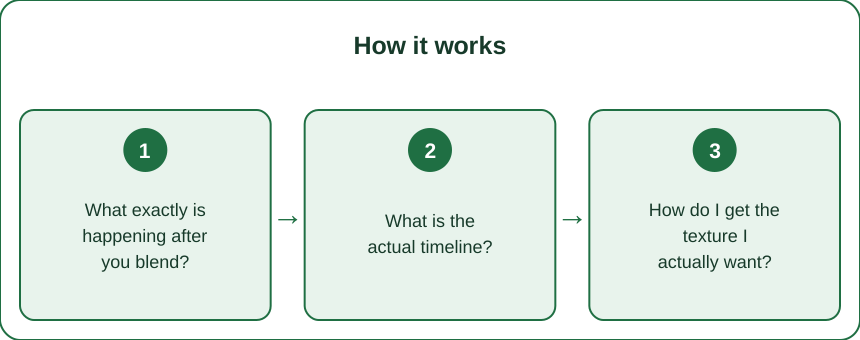
What exactly is happening after you blend?
Beta-glucan is the main actor. It is a soluble fibre that forms a viscous gel in water, and oats are one of the richest common sources. The gelling is not instant - it continues as the fibre hydrates fully.
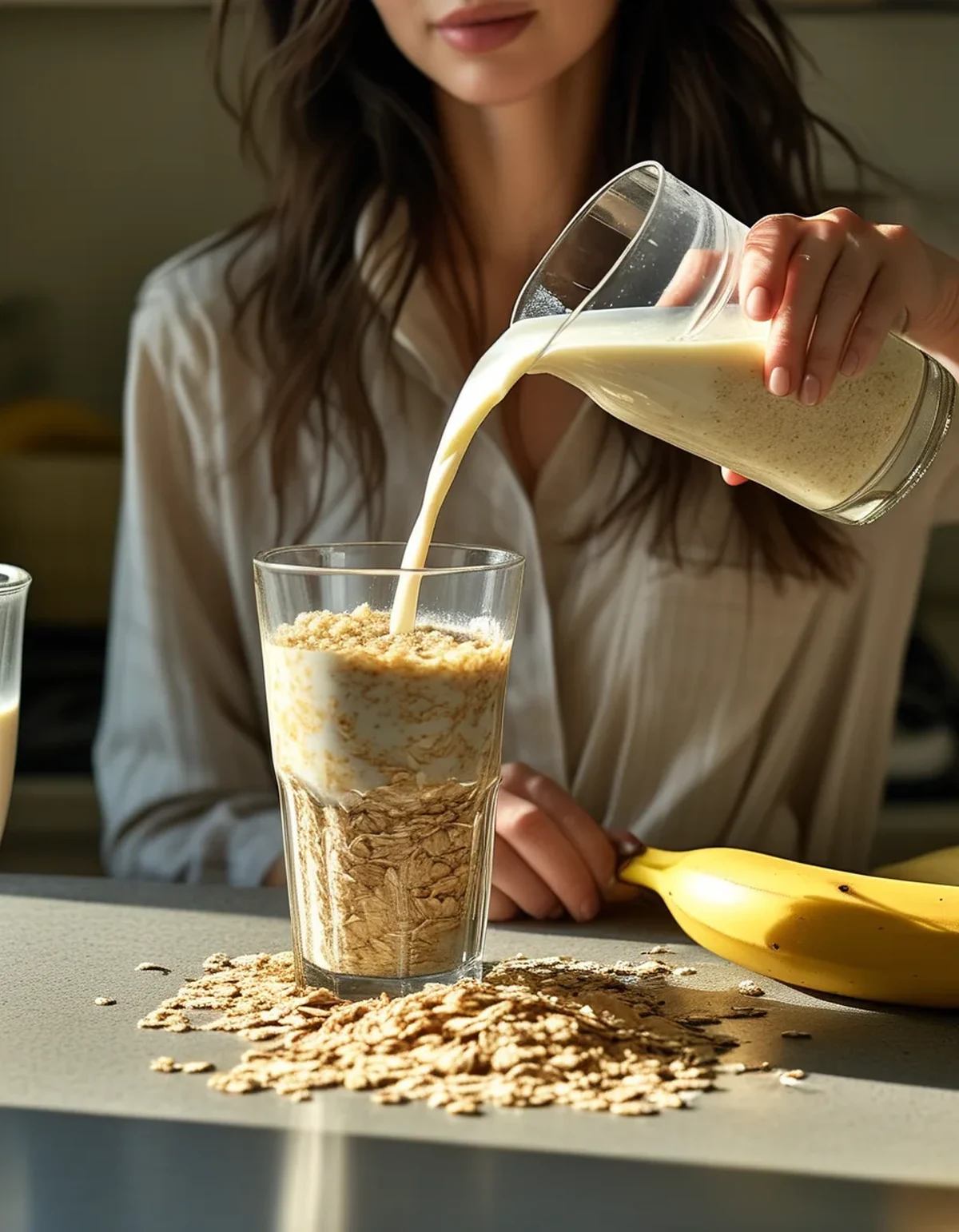
Blending accelerates it dramatically. Whole oats have an intact structure that slows water penetration. Blended oats have vastly more surface area exposed, so hydration that would take overnight in whole oats happens in an hour or two.
Starch adds a second, slower thickening. The mechanical action of the blades damages starch granules, and damaged starch absorbs cold water in a way intact starch does not. This is why the thickening keeps going even after the fibre has hydrated.
Temperature sets the speed. Warm smoothies thicken much faster than cold ones. A smoothie made with room-temperature milk will be paste well before a frozen-fruit version made identically.
And the oat type matters more than the quantity. Instant or quick oats are pre-processed and thicken fastest; steel-cut oats barely thicken at all in the same time because their structure is far more intact. Rolled oats sit in between.
What is the actual timeline?
Immediately after blending: thinner than it will ever be again. This is the moment people judge the recipe by, which is why so many make-ahead smoothies disappoint.
At 15 to 30 minutes: noticeably thicker but still drinkable. For most people this is the sweet spot - the texture has body without needing a spoon.
At 1 to 2 hours: substantially thicker. A smoothie made for a commute is often at this stage on arrival. Still drinkable through a wide straw, generally not through a narrow one.
At 4 hours or overnight: usually spoonable. This is the smoothie-bowl or overnight-oats territory, and it is a good outcome if that is what you planned and a poor one if you wanted a drink.
Refrigeration slows it but does not stop it. Cold reduces the rate meaningfully, so a fridge-stored smoothie at 4 hours is roughly where a counter-stored one is at 2 - useful but not a solution on its own.
And it does not reverse. Once the fibre and starch have hydrated, stirring redistributes but does not un-thicken. Only adding liquid changes it back.
How do I get the texture I actually want?
If you want it drinkable later, use half the oats and add liquid at the end. A typical smoothie takes 20 to 30 grams of oats; for a make-ahead, use 10 to 15 and add an extra 50 to 80ml of liquid.
Or keep the oats separate. Blend everything else, carry the oats in a small container, and stir them in when you drink it. This gives you full control and takes ten seconds.
Blend the oats first, alone, then add everything else. Dry-blending the oats to a flour disperses them evenly and produces a smoother texture without grit - though note this speeds up the hydration, so it is a texture fix rather than a thickening fix.
Add roughly 30% more liquid than looks right if you are making it ahead. This is the simplest reliable adjustment. It looks too thin at the moment of blending, which is exactly correct.
Use steel-cut or whole rolled oats rather than instant if you want the slowest thickening. The processing level is the biggest lever available, more than quantity.
And keep it cold and full. A full, sealed container refrigerated immediately thickens more slowly and oxidises less. Less air in the container helps both problems at once.
What Nobody Tells You About Oats in Smoothies
Raw oats are safe to eat, and the concern people half-remember is different. Rolled and instant oats are steamed during processing, so they are not truly raw in the food safety sense. They are perfectly fine blended into a cold drink.
Phytic acid gets mentioned and is largely a non-issue in a mixed diet - it binds some minerals, but soaking and the overall variety of what you eat make it unimportant for most people. Not a reason to avoid oats in a smoothie.
The satiety effect is genuinely real and it is the beta-glucan. Soluble fibre slows gastric emptying, which is the actual mechanism behind oats keeping you full - and it is also exactly the mechanism that thickens your drink. Same property, two effects.
Thickness itself increases fullness independently. Research on satiety consistently finds that thicker versions of the same drink are rated more filling. So an over-thickened smoothie is not a failure nutritionally - it is more satiating than the thin version was.
Oats also blunt the blood sugar response compared with a fruit-only smoothie, for the same fibre reason. If your smoothie leaves you hungry an hour later, adding oats is a more effective fix than adding protein powder for many people.
And the grit problem is a blender problem, not an oat problem. If your smoothie is gritty rather than thick, the oats were not broken down enough - dry-blend them first, or let the mixture sit five minutes and re-blend briefly.
What about the other thickeners?
Chia is far more extreme than oats. Chia absorbs roughly 10 to 12 times its weight in water and forms a distinct gel. One tablespoon will set a smoothie to pudding overnight, where oats merely thicken it.
Flaxseed sits between the two. Ground flax thickens noticeably but less dramatically, and it does most of its work in the first hour rather than continuing overnight.
Banana thickens by a different mechanism - it is starch and pectin, and frozen banana thickens mostly by being frozen. As it warms, a banana smoothie gets thinner, which is the opposite of oats. Combining the two produces a smoothie that thins then thickens.
Protein powder varies enormously by type. Casein thickens substantially over time; whey isolate barely does at all. If your smoothie mysteriously sets and there are no oats in it, check which protein you are using.
Yoghurt and nut butters thicken immediately and then stay put. They do not have a delayed action, which makes them the most predictable thickeners if you want texture without a timeline.
And stacking them is where people get caught. Oats plus chia plus banana plus casein is four thickeners, three of which keep working. Pick one delayed thickener at a time and the texture becomes predictable.
FAQ: Oats in Smoothies, Answered
Why does my oat smoothie get so thick in the fridge?
Beta-glucan fibre and blender-damaged starch keep absorbing water for hours. Refrigeration slows the process but does not stop it.
Can I stop it thickening?
Not entirely, but you can plan for it: use half the oats, add about 30% more liquid, keep it cold, or carry the oats separately and stir them in at the last minute.
Is it safe to eat raw oats in a smoothie?
Yes. Rolled and instant oats are steamed during processing, so they are not raw in the food safety sense, and they are fine in a cold drink.
Which oats thicken least?
Steel-cut, by a wide margin, because their structure stays largely intact. Instant oats thicken fastest, with rolled oats in between.
Can I thin it back out later?
Only by adding liquid. The hydration does not reverse - stirring redistributes the thickness but does not undo it.
Do oats actually make a smoothie more filling?
Yes, and by two mechanisms at once: soluble fibre slows gastric emptying, and thicker drinks are rated more filling than thin ones at identical composition.
TL;DR:
- Beta-glucan fibre plus blender-damaged starch keep absorbing water for hours after you stop blending.
- Timeline: drinkable at 15 to 30 minutes, notably thick at 1 to 2 hours, usually spoonable overnight.
- Processing level is the biggest lever - instant thickens fastest, steel-cut barely at all.
- For make-ahead: halve the oats, add about 30% more liquid, or carry the oats separately and stir in.
- It does not reverse. Only added liquid thins it back out.
- Do not stack delayed thickeners - oats plus chia plus casein is three things still working in the fridge.
An over-thick oat smoothie is not a nutritional failure. The same fibre that thickened it is what makes it filling.
Keep Reading
This article is for general informational purposes only and is not medical advice. Always consult a qualified health professional for guidance specific to you.