Why Adding Ice Makes Your Smoothie Taste Weaker, Not Just Colder
Quick Answer: Two things happen at once. Cold physically reduces the sensitivity of your sweet and aroma receptors, so an ice-cold smoothie tastes less sweet and less fruity than the identical mix at room temperature. And ice is frozen water — as it blends and melts, it dilutes everything. Frozen fruit gives you the same cold and thickness without either penalty, which is why it is the single best swap in smoothie making.
You taste it before you blend and it is great. You add a cup of ice, blend, taste again, and it has become vaguely fruit-flavored water. You did not imagine that.

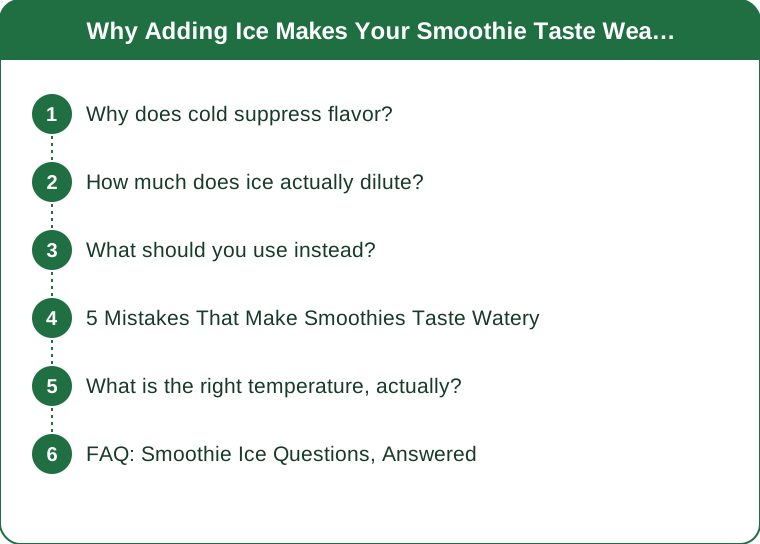
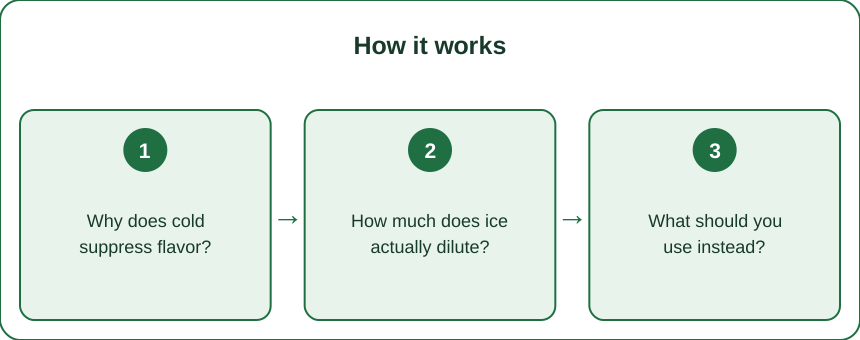
Why does cold suppress flavor?
Because taste receptors are temperature-sensitive proteins, and aroma needs volatility.
The receptors that detect sweetness belong to a family of channels whose activity depends on temperature. They respond most strongly in a range around body temperature and considerably less as things get cold. The practical result is that the same amount of sugar tastes measurably less sweet at 4°C than at 20°C. This is not a perception quirk; it is receptor chemistry.
Aroma is the bigger loss. Most of what you call flavor is smell, detected retronasally as volatile compounds travel from your mouth up into your nasal cavity. Volatility depends on temperature. Cold liquid releases far fewer aromatic molecules into the air, so the strawberry in a very cold smoothie is delivering a fraction of the aroma it delivers at room temperature.
You already know this from other foods. Ice cream tastes intensely sweet as it melts on your tongue and cloying when it has fully melted in the bowl — same sugar, different temperature. Cheap beer is served cold for exactly this reason.
The implication for smoothies is direct: a smoothie needs to be built sweeter and more aromatic than you would like it at room temperature, because a chunk of both is going to be suppressed by the cold you are about to add.
How much does ice actually dilute?
More than people estimate, and the estimate is easy to run.
A cup of ice cubes is roughly 120 grams of water once melted. If your smoothie is around 350–400 grams of actual ingredients, you have just added 30% water. You would never pour a third of a cup of water into a finished smoothie on purpose, and yet that is functionally what happened.
The timing is what disguises it. Ice does not dilute all at once. Some melts during blending from friction and blade heat, more melts as it sits. This is why smoothies get noticeably worse over ten minutes — you are drinking a progressively more dilute version of what you started with, and the coldness that was masking the weakness is fading at the same time.
So the flavor curve of an ice-based smoothie goes in exactly the wrong direction: it starts cold and thick and weak-tasting, then becomes warmer and thinner and only slightly more flavorful because the dilution has caught up with the temperature recovery.
There is also a texture consequence. Ice does not blend into a smooth continuous phase the way frozen fruit does — it shatters into small hard fragments that stay distinct. That grainy, slightly slushy texture that never fully goes away no matter how long you run the blender is ice, not fruit.
What should you use instead?
Frozen versions of things that already belong in the drink.
Frozen fruit is the default answer. It provides the same cold and considerably more thickness, and every gram of it contributes flavor, sugar, and fiber instead of water. Frozen banana is the most effective single ingredient in smoothie making — the starch and pectin create a genuinely creamy body that ice cannot approach.
Frozen greens work the same way. Spinach freezes well, blends smoother from frozen than fresh, and contributes cold without water.
Freeze your liquid. This is the underused move. Pour milk, coconut milk, coffee, or juice into an ice cube tray. You get the cold of ice with none of the dilution, because the frozen thing is the same thing that was already in the drink. Frozen coffee cubes in a coffee smoothie are a genuine upgrade.
Frozen avocado or frozen cauliflower rice for thickness without sweetness, if you are trying to keep sugar down. Cauliflower is close to flavorless in a fruit smoothie and does remarkable things for body.
If you must use ice, use less than you think, add it last, and blend for the shortest time that works. And compensate for the suppression: a little more sweetener, a pinch of salt, or an acid like lemon juice, all of which push back against the flattening.
The freezer prep that makes this easy: portion fruit into bags on the day you buy it. Fresh fruit that never gets frozen becomes the fruit that goes bad, and then you are back to ice.

5 Mistakes That Make Smoothies Taste Watery
1. Using ice and frozen fruit together out of habit. If you already have frozen fruit in there, the ice is contributing nothing but water and grit. Pick one, and make it the fruit.
2. Adding liquid first and generously. Most recipes call for liquid first for blending reasons, which is correct — but the amount matters enormously. Start with half what you think you need. You can always add more mid-blend; you cannot remove it.
3. Skipping salt. A pinch of salt in a sweet smoothie sounds wrong and works remarkably well. Salt suppresses bitterness and amplifies perceived sweetness, and it is the fastest fix for a smoothie that tastes flat but is not actually under-sweetened.
4. Skipping acid. A squeeze of lemon or lime brightens everything and specifically counteracts the dulling effect of cold. This is why smoothie shop versions taste more vivid than yours — a lot of them have citrus in the base you would not think to add.
5. Over-blending. Long blending generates heat, which melts more ice and thins the drink, then you add more ice to compensate, and the cycle repeats. Blend until just smooth and stop. Thirty to forty-five seconds is usually enough with frozen fruit.
What is the right temperature, actually?
Cold enough to be refreshing, not so cold that it mutes everything. There is a real sweet spot.
In practice this means a smoothie made with frozen fruit and refrigerated liquid, not with ice and freezer-cold everything. That lands you somewhere around 4–7°C, which reads as properly cold while leaving enough receptor sensitivity and aromatic volatility to actually taste the ingredients.
A few things follow from that:
- Let it sit sixty seconds before drinking if it came out very cold and slushy. The flavor genuinely improves and the texture loosens.
- Use room temperature or fridge-cold liquid, not the coldest thing available, when your fruit is already frozen.
- Taste and adjust after blending, not before. The pre-blend taste is misleading in exactly the way this article is about — it is warm, so it tastes stronger than the finished drink will.
For late summer specifically, when you actually want the drink very cold, the play is to build the flavor up rather than accept the loss: more ripe fruit, a squeeze of citrus, a pinch of salt, and a slightly more aromatic addition like vanilla, cinnamon, or fresh mint. Aromatics that are volatile at low temperature — mint especially — punch through cold better than most fruit flavors do, which is why mint works so well in cold drinks and so mildly in hot ones.
And if the smoothie is going in a bottle for later, the calculus changes again: build it slightly stronger than you want, because it will dilute and warm on the way to wherever you are drinking it.
FAQ: Smoothie Ice Questions, Answered
Why does the smoothie shop version taste better then?
Several reasons stacking. Commercial blenders are powerful enough to make ice genuinely smooth rather than grainy, most shops use frozen fruit rather than ice as the base, and there is usually more sugar and more acid than you would put in at home. Some also use fruit purees or sorbet bases, which are dense and sweet and never watery.
Does blending destroy nutrients?
Blending breaks cell walls, which actually makes some nutrients more available. The real losses are small and mostly from oxidation over time, not from the blending itself — which is a good argument for drinking it fresh rather than for avoiding the blender.
Can I freeze a finished smoothie?
You can, and it is better than making one with ice. Freeze it in portions, then blend the frozen block with a small splash of liquid. You get the cold from the smoothie itself rather than from added water. Expect some separation and a slightly different texture, and give it a few minutes out of the freezer before blending.
TL;DR:
- Cold reduces sweet-receptor sensitivity and cuts aroma volatility, so cold food genuinely tastes weaker
- A cup of ice adds roughly 30% water to a typical smoothie, and it keeps diluting as it melts
- Use frozen fruit, frozen greens, or frozen cubes of your own liquid instead
- Fight the suppression with a pinch of salt, a squeeze of citrus, and slightly riper fruit
The fix costs nothing and takes no extra time. It just requires putting the fruit in the freezer on the day you buy it rather than the day you give up on it.
Keep Reading
This article is for general informational purposes only and is not medical advice. Always consult a qualified health professional for guidance specific to you.