Does Blending Fruit Into a Smoothie Actually Destroy Its Fiber Content?
Quick Answer: Blending doesn’t destroy fiber in a chemical sense — the total fiber content stays essentially the same as the whole fruit that went in — but blending does physically break fiber into smaller particles, which can make a smoothie digest faster and feel less filling than eating the same fruit whole, even though the fiber grams on paper are identical.

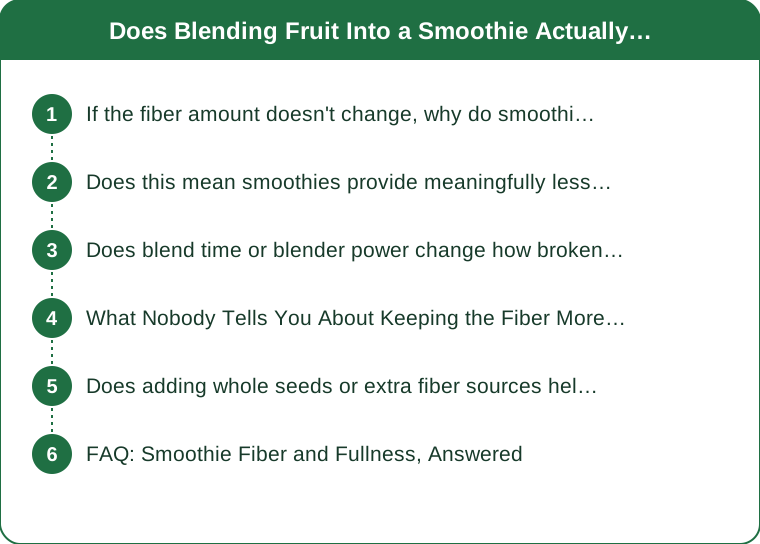
If the fiber amount doesn’t change, why do smoothies feel less filling?
Blending breaks fiber’s cellular structure into much smaller pieces, and this smaller particle size means your digestive system processes the smoothie faster than it would whole fruit, leading to quicker gastric emptying and a shorter-lived feeling of fullness, even though the fiber gram count on a nutrition label is unchanged.
Does this mean smoothies provide meaningfully less nutritional benefit than whole fruit?
Not in terms of vitamins, minerals, or total fiber content, which remain essentially intact through blending — the difference is specifically about satiety and digestion speed, not a loss of the fiber or nutrients themselves, so smoothies aren’t nutritionally inferior, just digested differently.
Does blend time or blender power change how broken-down the fiber gets?
Yes — longer blending times and higher-powered blenders break fiber into progressively smaller particles, which can further speed up digestion and reduce satiety compared to a shorter, chunkier blend — this is one reason a quick, less-thorough blend can feel more filling than an ultra-smooth one.

What Nobody Tells You About Keeping the Fiber More Intact
Leaving some fruit pulp or skin less finely blended, rather than pursuing a perfectly smooth texture, preserves more of fiber’s satiety-supporting structure — a slightly chunkier smoothie, or one blended for less time, tends to feel more filling than an ultra-processed, perfectly smooth version with identical ingredients.
Does adding whole seeds or extra fiber sources help offset this effect?
Yes — adding chia seeds, flax, or extra vegetables with intact fiber structure can help increase overall satiety even in a smooth-blended drink, since these add-ins provide some fiber that wasn’t broken down as extensively as the base fruit.
FAQ: Smoothie Fiber and Fullness, Answered
Is juicing worse for fiber than blending?
Yes, significantly — juicing typically removes the fiber-containing pulp entirely, while blending keeps all the fiber in the drink, just in smaller particle form, making blending meaningfully better for fiber retention than juicing.
Does adding protein to a smoothie help offset the faster digestion issue?
Yes — protein slows gastric emptying and adds its own satiety effect, which can meaningfully counteract a smoothie’s faster fiber digestion and improve how filling it feels overall.
Should smoothies be eaten with a spoon instead of a straw for better fullness?
Some people find eating a thicker smoothie with a spoon slows consumption pace and increases perceived fullness compared to drinking quickly through a straw, though this varies by individual habit.
TL;DR:
- Blending doesn’t destroy fiber content — the fiber grams stay essentially the same as whole fruit
- It does break fiber into smaller particles, speeding digestion and reducing lasting fullness
- Longer blend times and higher-powered blenders break fiber down further
- Adding protein, chia, or leaving a chunkier texture can help offset the satiety difference
The fiber is still there nutritionally — it just gets processed differently by your body than the same fiber eaten whole.
Keep Reading
This article is for general informational purposes only and is not medical advice. Always consult a qualified health professional for guidance specific to you.