The Best Dairy-Free Protein Options for Smoothies When Whey Isn't an Option
Quick Answer: Pea protein and a pea-rice blend give the closest texture to whey without dairy, while whey isolate (not concentrate) is often tolerated better by mildly lactose-sensitive people since it contains minimal lactose. Test with a small amount first if you’re unsure how your body responds.
Cutting dairy doesn’t have to mean giving up a filling, protein-packed smoothie — it just means being a little more deliberate about which powder or ingredient you reach for, since not all dairy-free options blend or taste the same.

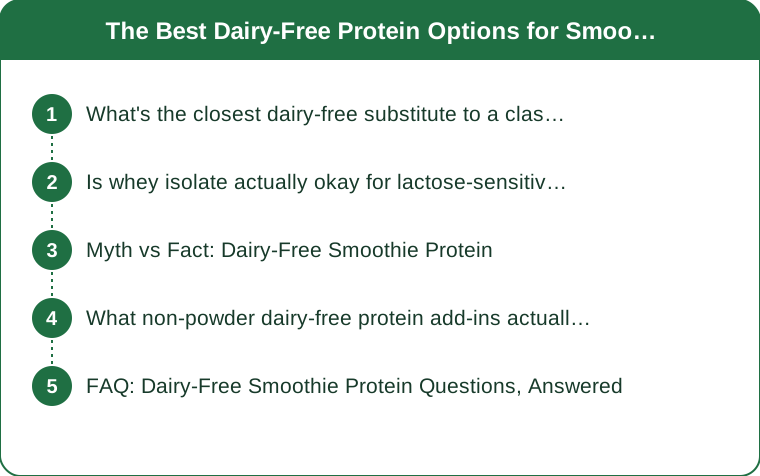
What’s the closest dairy-free substitute to a classic whey smoothie texture?
Pea protein blended with rice protein is generally considered the closest match, since the combination rounds out pea protein’s slightly chalky texture and gives a more complete amino acid profile similar to whey. On its own, pea protein can taste a bit earthy or thick, but blended with a ripe banana or frozen fruit, most people don’t notice much difference from a dairy-based shake.
Single-source plant proteins like straight pea or straight hemp tend to be thicker and more textured than a blend, so if smoothness is your priority, look for a blend specifically. A high-powered blender also makes a bigger difference with plant proteins than with whey, since thorough blending is what breaks down any remaining grittiness.
Is whey isolate actually okay for lactose-sensitive people?
For many mildly lactose-sensitive people, yes — whey protein isolate goes through additional filtering that removes most of the lactose, unlike whey concentrate, which retains more. This is why some people who react to regular dairy products tolerate whey isolate smoothies just fine, though this varies by individual sensitivity level.
If you have a diagnosed dairy allergy (not just lactose intolerance), this distinction doesn’t apply — an allergy requires avoiding whey protein entirely regardless of filtering, since the reaction is to the protein itself, not the lactose sugar.

Myth vs Fact: Dairy-Free Smoothie Protein
Myth: All plant proteins taste equally chalky and gritty. Fact: Texture varies significantly by source and processing — a good pea-rice blend with the right liquid ratio can be nearly indistinguishable from whey once blended with fruit.
Myth: Plant proteins don’t have complete amino acid profiles. Fact: Individual plant sources may be incomplete, but blends (like pea plus rice) are specifically formulated to cover the full amino acid range.
Myth: Collagen protein is a good vegan dairy-free option. Fact: Collagen is an animal product (typically bovine or fish-derived) and isn’t vegan or vegetarian, even though it’s dairy-free — check the source if that distinction matters to you.
What non-powder dairy-free protein add-ins actually work in a smoothie?
Silken tofu blends completely smooth and adds protein with almost no flavor impact, making it a great base-thickener alternative to Greek yogurt. Nut or seed butters (almond, peanut, sunflower seed) add protein plus healthy fats, though they add more calories and a stronger flavor than a neutral powder.
Unsweetened plant-based Greek-style yogurt alternatives (coconut, almond, or soy-based) have also improved significantly in texture and can replace dairy Greek yogurt in a smoothie almost directly, cup for cup. Combining two of these add-ins — tofu for smoothness plus a spoonful of nut butter for flavor — often gets closer to a dairy-based shake’s richness than either one used alone.
FAQ: Dairy-Free Smoothie Protein Questions, Answered
Which dairy-free protein powder blends best without a high-powered blender?
Pea-rice blends and soy protein isolate tend to dissolve more smoothly in standard blenders than straight hemp, which can leave a gritty texture without high-speed blending.
Can I just use more fruit instead of a protein powder for a filling smoothie?
Fruit adds fiber and some sweetness but very little protein — pairing fruit with a protein source (powder, tofu, or nut butter) is what actually makes a smoothie filling and satiating.
Is soy protein a good dairy-free option?
Yes — soy protein isolate is a complete protein source with a mild flavor that blends well, making it one of the more versatile dairy-free options available. This is general information, not medical advice for specific allergies or conditions.
TL;DR:
- Pea-rice protein blends give the closest texture to a classic whey smoothie
- Whey isolate may work for mild lactose sensitivity, but not for a true dairy allergy
- Silken tofu and nut butters are solid non-powder dairy-free protein add-ins
- Pair any protein source with fruit for the most filling, satisfying result
Dairy-free doesn’t mean protein-free or flavor-free — it just takes picking the right base for your blender and your taste. This is general information, not medical advice.
Keep Reading
This article is for general informational purposes only and is not medical advice. Always consult a qualified health professional for guidance specific to you.